Many simplified, intro, or “plain-English” WCAG re-interpretations frame Success Criterion 2.1.1 Keyboard as ensuring a control or widget or thing can be operated with a keyboard. Some go further and also ask you to consider keyboard-like devices. Very few (I counted 1 out of 10) pay attention to the part…
Maybe not, but I’ll break these down into three categories because it depends on context and intent. Pretend this post also applies for pressing Esc. Action Required If the user must complete a task that is presented by the dialog, then they should not be able to close it without…
This is a redress of my 2019 post Link + Disclosure Widget Navigation, except (as the title implies), I’ve modified it to use native HTML popovers instead of ARIA or HTML disclosure widgets. Popover has the benefit of using appropriate HTML structure and semantics while removing the need for scripting…
Chrome 150 has landed support for focusgroup, a feature proposed by Open-UI and not yet in WHATWG HTML as anything more than a feature request. Open-UI has outsized representation from Google and Microsoft folks, so it’s no surprise Chrome would implement it first. “FOCUS!” by Metro Centric, CC BY 2.0;…
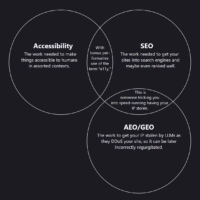
Using SEO (search engine optimization) to justify accessibility was only ever a technique for bosses or clients or stakeholders who see accessibility as a cost center and are typically driven more by dashboards or money. Ideally, you want to get past that ASAP to drive better outcomes for humans, not…
Hi, just me heading off some bad advice I’m starting to see in developer venues. Background The proposed Document Outline Algorithm, where headings would automatically reset themselves to the appropriate level based on their position in the DOM structure, was never part of a final HTML specification. It was quickly…
Just in time for Google I/O, the Chrome for Developers site announced Modern Web Guidance (MWG): Modern Web Guidance is a set of evergreen and expert-vetted skills that guide your AI coding agents across many common use cases to build modern web experiences that are accessible, performant, and secure. Build…
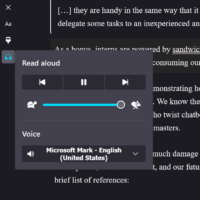
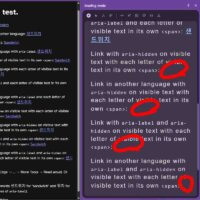
Users can customize the features built into the browser, something not often available from third-party approaches. Is an “AI” company offering to provide spoken versions of your pages for users? Is an overlay company promising to make your content more accessible by its overlay speaking it? Is some other vendor…
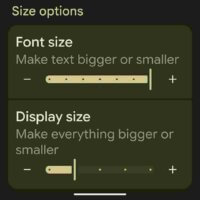
If your users scale the text size in Android or iDeviceOS, that doesn’t always affect the size of text on a web page. It’s a function of browser and authored code, as opposed to a standardized approach. That may be changing. Support The current state of affairs in the three…
Today Temani Afif asked a question: Are the below codes equivalent if we consider all the aspects? (a11y, semantic, something else maybe?) If not, what is missing (or should be changed) in the second code CSS by T. Afif (@css@front-end.social) 22 January 2026, 2:52pm I have my canned response that…
Identifying keyboard shortcuts for an application is mostly an internationalization problem. It’s also not a new problem. A recent (to me) example is the WordPress Gutenberg team starting to discuss keyboard shortcuts in 2017, addressing what will and won’t work across keyboards for different languages. Sight gag for my old…
This is meant to use voice control to test select menus (and other fields, but the title would be less weird) by their value because their accessible names are hidden. I’m sharing results of that testing. This was partially driven by: WCAG issue #3808 SC 3.3.2: Labels or Instructions and…