Now that HTML5 is starting to crack the mainstream, misunderstood and misrepresented though it may be , it makes sense that more and more developers and contributors should start to struggle with the shifting assignment of semantic meaning to the HTML5 elements. I wrote about this on Halloween in my…
Last Monday I wrote about some recent changes to the WHATWG HTML5 draft spec (HTML5 kills [time], Resurrects [u]), which then lead to my post discussing how the process to adjust the HTML5 spec only serves to confuse developers (End of <time> Is Not Helping the Case for HTML5). Then…
You may have heard some rumors that Flash is going away. You may read it as vindication for Steve Jobs. You may have decided web development will now change. You may be under the impression that HTML5 can do all the things Flash can. You can be excused when you…
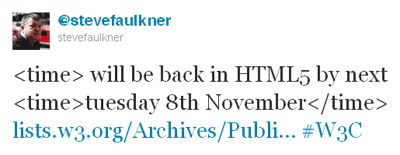
The decision to allow <time> back into the HTML5 fold has been made. Just like that, one element is restored. This recent dust-up still tells me that all the elements are always in peril. You can read the full decision in the email archives. This section of the email describing…
Yesterday afternoon I posted a general overview of recent changes in HTML5, focusing on this weekend’s development over the removal of <time>: HTML5 kills <time>, Resurrects <u> I thought I was already a little late to the party, but apparently not so. With the start of the week people swung…
The HTML5 specification as managed by both W3C and WHATWG is an unfinished, incomplete specification that can change at any time. That isn’t a criticism, it’s just a statement of fact. It’s a fact often ignored by people and companies who choose to implement it and then cry foul when…
When the guy who coined the term “Responsive Web Design,” has written a book about it, and is well regarded throughout the industry is asked to name his 20 favorite responsive sites, you should expect top-notch examples of sites that use CSS to respond to nearly any medium. Except that…
Since I started working on the web (and was slowly coaxed to the world of Netscape from Mosaic and HotJava), clients have asked me to find ways to adjust how a page behaves based on what browser the end user has. Before campaigns like the Web Standards Project (WaSP) took…
This article was originally posted on evolt.org, an online resource for web developers, maintained by web developers. I have granted evolt.org the right to use this article on its web site, and it is the only entity with the right to reproduce it. As web browsing technology continues to change…
Amazon’s long-awaited tablet/e-reader was formally announced today, and the conversations about whether or not it will compete the iPad are underway. I don’t much care about that. I am far more interested in the web browser that it includes. Amazon Silk is a new web browser, built on Webkit, and…
I downloaded and installed Adobe’s new web design tool, Muse (code name) (also at Adobe Labs) out of morbid curiosity. Just like Adobe Edge (which refuses to launch), I had very little expectation that this would be a fully-developed sales-ready product. Instead of getting into extensive detail about the quality…
Guns don’t kill people, the bullets do that (unless you pistol-whip someone to death, which means you probably ran out of bullets). Similarly HTML5, JavaScript, CSS and even Flash aren’t dangerous on their own, but in the wrong hands and with the wrong motives they can do harm. I wrote…