At the start of 2016 I wrote Internet Explorer Does Not Go Away Today because back then IE up to version 11 was being retired. But not Internet Explorer 11. I asked an AI (Neural Blender) to give me a picture of the Internet Explorer logo on fire. It’s almost…
I have spent a few years banging on about ensuring scrolling areas on a page are accessible to keyboard-only users. This is partly because the term “keyboard” maps to other input types that we distill to “keyboard” for ease of reference (speech input, sip-and-puff, on-screen keyboards, scanning software, etc.). When…
9 May 2023: The 2.5.8 language has changed. For the latest bookmarklet and language, skip ahead to the 9 May update. The proposed WCAG version 2.2 has gone through a bunch of revisions since I covered the first draft in 2020. One new success criterion that persisted is 2.5.8 Target…
I made some pointless things again. The First One See the Pen Best viewed in… by Adrian Roselli (@aardrian) on CodePen. A spinning box for each word is not exactly a compelling interface element, I admit, but I based it off this old tweet that was sitting around in a…
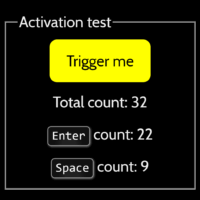
Keyboard interaction note for just one control from the entire panoply of HTML controls: A native <button> fires on key down when that key is Enter. If you hold down the Enter key, it continues to fire for as long you hold Enter (or something crashes). A native <button> fires…
If you have little experience with ARIA, screen readers, or testing in general, understanding accessible descriptions can be trickier than understanding accessible names (already confusing for many). I have written explanations so many times for clients and in fora that I opted to put this together so I maybe never…
Data tables need column headers. Monolitten, a granite column of humans (each with a head) at Vigelandsanlegget, a sculpture park in Frognerparken in Oslo, Norway. What they probably do not need is a new set of column headers every few rows, particularly not when they change the meaning of the…
This post serves no purpose other than to demonstrate the fidelity of screen readers when announcing non-emoji Unicode characters when using default settings. There is no judgment on which is correct. This is simply for reference. I grabbed the following tweet and recorded it across common screen readers (WordPress ate…
The title of this post is pretty specific. It relates to the meme on Twitter where users identify a trait or preference that they see as problematic, and identify it as a red flag. The emoji represents the red flag. For example: A stylized red flag Blaming Screen Readers 🚩🚩🚩🚩🚩…
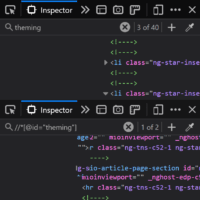
Chrome, Firefox, and Safari (the latter as confirmed by Al in the comments) support XPath searches when in the DOM view of their dev tools. Because the browser cleans whatever HTML it encounters (closing tags, correcting nesting), XPath can operate on the code as XML. Simple checks like finding a…
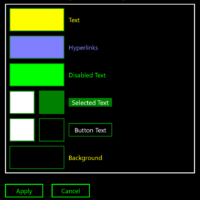
Outline: Feature Queries Proprietary, or Internet Explorer Only Standards Track, or Edge Only Frankenquery’s Monster System Colors CSS2 System Color Keywords WHCM Proprietary Feature Query Color Mappings CSS4 System Color Keywords Browser Support Internet Explorer Legacy Edge (Ledgacy) Chromium Edge (Chromiedge) Firefox Chrome Examples Backgrounds Inline SVGs SVGs via <img>s…
Update In early July 2022 I re-tested these to see how the results shaped up after nearly two years and at least one promise: It’s Mid-2022 and Browsers (Mostly Safari) Still Break Accessibility via Display Properties If the title is not clear, one browser stands out in failing to address…