Disclaimer: This post and the headline is my opinion. I provide facts throughout to inform that opinion. I say this because accessiBe managed to get $40 million in two rounds of funding from K1 Capital and I am guessing some of that money will be allocated to attorney fees. I…
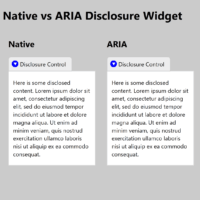
A disclosure widget is a simple control whose sole purpose is to hide or show stuff. Native HTML has one built in via the <details> and <summary> elements. Until recently, if you wanted to use it in modern browsers you needed to use a polyfill. In most cases it was…
HTML has all sorts of built-in features that, when used correctly, are accessible, will localize, and which just work. For example, if I want a button, I use <button>, and a screen reader will announce it as button. For users in other languages, they will hear whatever is their word…
The moment you change it. As soon as you start to tweak the underlying code or aspects of the design, you run the risk of introducing bugs. That part should be easy for any developer to understand. The tougher part to get your arms around is that once you add…
Please do not use this post as an excuse to beat up the devs at Apple or Google. If you are doing that, you have missed the point of this post and you are being unnecessarily mean to individuals who may have no control over broader organizational decisions. Do not…
The good:Chrome 80 rolled out on 19 February 2020, and with it came a pile of fixes for how elements with CSS display properties have their semantics exposed in the accessibility tree. These huge accessibility bug fixes featured prominently in my CSUN talk this year (starting at slide 36). The…
While originally I was scheduled to attend CSUN to present two talks one talk, I ended up not attending (my father won A Major Award so I joined him instead). I gave my talk remotely in my scheduled slot (during my father’s award dinner). While I would have loved to…
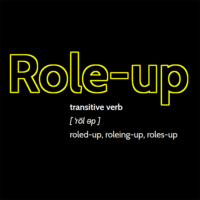
transitive verb [ ‘rōl əp ] roled-up, roleing-up, roles-up Definition of role-up To use an ARIA role on an HTML element to change its semantics and/or force it to accept an accessible name (via aria-label, aria-labelledby, or even aria-describedby). To add ARIA roles everywhere without understanding, often via framework or…
TL;DR: Regardless of what accessibility conformance level you target, do not arbitrarily open links in a new window or tab. If you are required to do so anyway, inform users in visible text. Overview Throughout this post I am going to use the terms browser window and tab interchangeably. While…
This year the a11yTO team put together its third conference, adding a day for the built environment (#a11yIRL) and another day for gaming (#a11yTOGaming), bringing the entire conference to four days. The collection of three conferences has been branded #a11yWeekTO. Throughout the conference, attendees were incredibly positive about the venue,…
Since the early days of the web, when images could be floated and text would wrap around them, designers have wanted to bring drop caps onto the web. Then we learned how terrible a pattern like <img alt=”M” align=”left”>atthew is for users, and CSS introduced :first-letter, letting us believe all…