Here is the priority I follow when assigning an accessible name to a control: Native HTML techniques, aria-labelledby pointing at existing visible text, Visibly-hidden content that is still in the page, aria-label. Too often folks will grab ARIA first to provide an accessible name for a thing. Or they may…
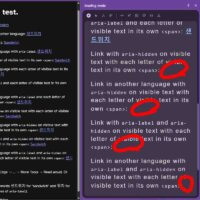
As of my 25 July 2025 update at the end of this post, aria-label auto-translation support is less spotty than when I first wrote this post, but still unreliable. It does, actually. Sometimes. One of the big risks of using ARIA to define text content is that it often gets…
Heading this off early: uniquity uniq·ui·ty; \ yüˈnikwətē, -wətē, -i \Uniqueness; quality of being unique. There is a place where accessibility practitioners hang out and try to out-do each other with niche knowledge of nuance. While loitering in one, a question came up about text fields that have the same…
Many of my clients over the years have relied on fields in tables. Sometimes a checkbox to select a row, sometimes text inputs to update information, sometimes buttons select something. Rarely are they interested in a block of label text above the field, and I cannot disagree with them. The…
I am not speaking on behalf of the W3C nor the W3C Accessibility Guidelines Working Group (AGWG), nor am I a member, nor does anyone who is member know I am writing this, nor do I have any insider knowledge. For years I have seen people, teams, products, organizations, and…
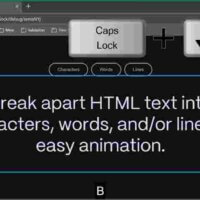
This is an unplanned part two for Barriers from Links with ARIA. The title reflects my exasperation because this isn’t new, I’ve simply failed to be explicit about it over the last decade or so. In 2012 I vented about TypeButter using <kern style=”letter-spacing: -0.01em;”> for each letter. In 2020…
Today Temani Afif asked a question: Are the below codes equivalent if we consider all the aspects? (a11y, semantic, something else maybe?) If not, what is missing (or should be changed) in the second code CSS by T. Afif (@css@front-end.social) 22 January 2026, 2:52pm I have my canned response that…
This post does not discuss whether live regions are good, nor is it a post about the best way to use them. This post only covers how they are exposed to the audience who experiences them — screen reader users. Written by a non-screen-reader user. If you’re here because your…
ACRs are Accessibility Conformance Reports, which are the output of a VPAT, or Voluntary Product Accessibility Template maintained by ITIC, or the Information Technology Industry Council (which is why VPAT often has a ® symbol hanging off it). An organization may fill out the template to indicate how or if…
This is meant to use voice control to test select menus (and other fields, but the title would be less weird) by their value because their accessible names are hidden. I’m sharing results of that testing. This was partially driven by: WCAG issue #3808 SC 3.3.2: Labels or Instructions and…
OpenAI has announced it’s launched a new browser, Atlas, with ChatGPT built in. For those familiar with ARIA, OpenAI outlines what to expect (I left the code as I found it, other than removing the target): We’ll continue to make Atlas better, and our roadmap includes multi-profile support, improved developer…
Abstract for my session Talkin’ Tables, which I presented in place of another speaker who had to back out the day before: This session will walk through the basics of how to construct an HTML table. More than basic structure, it will talk about support and how it is exposed…