The Test Page The Code Testing Results Keyboard Screen Readers Voice Control, Forced Colors, Speed Media Queries: 20 December 2023 Audio Description: 20 December 2023 Wrap-up Browsers each provide built-in video players for the <video> element. Nearly four years ago Scott Vinkle wrote How accessible is the HTML video player?,…
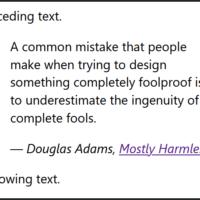
TL;DR: This post does not assert the correct way to code blockquotes, it will only demonstrate how screen readers announce some existing patterns. Test Details The first four examples are lifted from WHATWG HTML’s <blockquote> entry. The next three are from W3C HTML’s 2019 <blockquote> guidance (the W3C HTML spec…
There is a non-zero chance that WCAG Success Criterion 4.1.1 Parsing will go away in WCAG 2.2. This isn’t a problem for users, regardless of the problems it may pose for the WCAG process, ACT rules, automated testing tools, or ossified testing processes. The joke here is using an antique…
Another post where I lay it all out in the title. What follows is why I am making this assertion (with a handy table of contents). Timeline 26 May 2022 at 10:58am ET 26 May 2022 at 7:56pm ET 27 May 2022 at 7:38pm ET 28 May 2022 at 5:04pm…
This is a slightly extended version of my Twitter thread. As the W3C has embarked on a full web property rebuild, its vendor (Studio24) indirectly announced earlier this month that it had dropped WordPress from consideration as a CMS. WPTavern took issue with this yesterday, and Studio24 responded today, (politely)…
WCAG 2.2 is live. Read the W3C’s What’s New in WCAG 2.2 to know what from this wildly outdated post made it into the final spec. The latest (and probably last) WCAG version 2 point release is in draft and the W3C is asking for comments and feedback by 18…
In 1994 the World Wide Web Consortium (W3C) formed to help wrangle the web into a standards-based platform. The W3C has persisted and created piles of material for web developers. Pulling from its anniversary post: Some of the Web Consortium’s most important contributions to the Web include: Hundreds of open…
TL;DR: Regardless of what accessibility conformance level you target, try to ensure that interactive controls are at least 44 by 44 pixels in size. Links in blocks of text are exempt. Overview In real life there is typically both a visual and tactile component to an interface. You have to…
The world wide web has officially lasted 30 consecutive years, which means it’s catching up to its parent, the Internet, which itself is bearing down on 50. That’s an important distinction. The Internet is not the web; it is the foundation on which the web was born. In honor of…
The Web Content Accessibility Guidelines (WCAG) does a good job of providing supporting techniques to help reviewers determine if a specific case would violate a given Success Criterion (SC). WCAG 2.0, which became a recommendation at the end of 2008, has carried these techniques over to WCAG 2.1, finalized in…
Due to lack of overwhelming request, you can download this logo (SVG). By now it is old news, in Internet time, that Microsoft Edge will replace its rendering engine with Chromium. Nearly six years ago I wrote about Opera dumping Presto to move to Chromium. The landscape is slightly different…
I field questions pretty regularly about what is coming in WCAG 2.1. I have offered links to the spec, pointers to W3C mailing list email, references to other posts (most recently David MacDonald’s post that looks at the same version as this post), but have avoided gathering them in one…