Guns don’t kill people, the bullets do that (unless you pistol-whip someone to death, which means you probably ran out of bullets). Similarly HTML5, JavaScript, CSS and even Flash aren’t dangerous on their own, but in the wrong hands and with the wrong motives they can do harm. I wrote…
You may recall from my post in February, WebM, H.264 Debate Still Going, that the H.264 video codec is considered patent-encumbered (which resulted in its dismissal from the HTML5 specification) and Google has argued that its own WebM / VP8 codec is made up of patents it owns, releasing it…
This photo represents some of the technologies (pint glasses) that HTML5 (t-shirt) is thought to encompass (drink). The horror of that concept is represented by the hands (defensive wounds coming).I had the pleasure of sharing some pints with Bruce Lawson and Chris Mills last week in London. While discussing what…
This article was originally posted on evolt.org, an online resource for web developers, maintained by web developers. I have granted evolt.org the right to use this article on its web site, and it is the only entity with the right to reproduce it. While spending some time hacking through experiments…
It’s only been 13 years, but CSS version 2.1 is now officially a W3C Recommendation — essentially meaning the specification is final. Which of course means you are now all free to use it in your web pages. CSS2 became a W3C Recommendation on May 12, 1998, over 13 years…
If you follow the ongoing developments of HTML5, by which I mean the W3C specification and not the regular JavaScript and CSS sites-of-cool-gee-whiz bandied about across the web (Apple.com (Not Really) Updated to HTML5, Google Doodle: Bouncy Balls Aren’t HTML5, Google, Arcade Fire Confused on HTML5), then you probably know…
Nearly two weeks ago I wrote up a post outlining the W3C decision to no longer require the alt attribute on images in HTML5: Image alt Attributes Not Always Required in HTML5. I was genuinely surprised to see that was the most popular post on this blog and garnered the…
It has long been accepted that the alt attribute of the <img> element, while not a perfect method to provide a text alternative to an image, is still a necessary attribute to provide at least some level of access to the image content for users who cannot see the image…
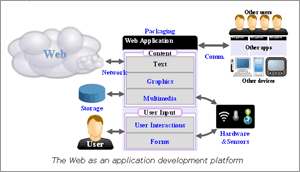
The W3C has taken a step toward gathering all the information relevant to the mobile web, as authored by its disparate working groups, under one umbrella as a singular (recurring) reference source: Standards for Web Applications on Mobile: February 2011 current state and roadmap (read the accompanying W3C blog post).…
Apple has released a revamped version of its web site today, ostensibly in HTML5. Except it doesn’t use anything from HTML5. That Apple wants to move to the platform that it touts as the Flash-killer is not surprising. Apple refuses to allow Adobe Flash on its mobile devices and claims…
There is so much buzz now and in the past week that it’s hard to pick out only a few items to address. I still have an opinion on just about everything going on with the spec, W3C, WHATWG, additional specs, the “pundits,” and many other things that could lead…
The W3C has rolled back its definition of what the new HTML5 logo represents: This logo represents HTML5, the cornerstone for modern Web applications. In case that isn’t clear, which it might not be, the FAQ gets far more specific on the inclusion of CSS3 in the logo definition (emphasis…